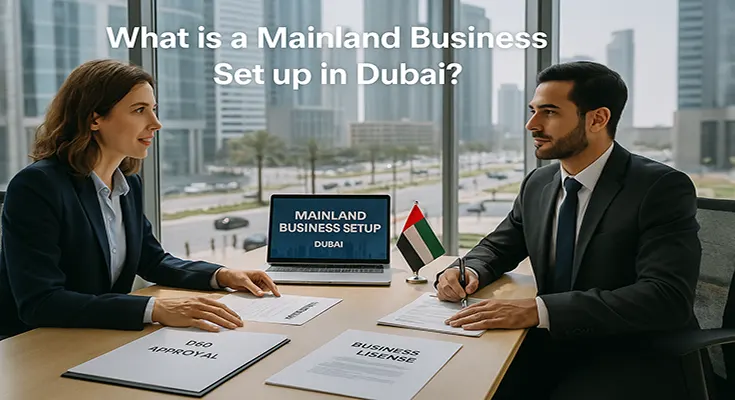
A mainland business set up in Dubai refers to establishing a company directly registered with the Department of Economy and Tourism (DET, formerly DED) in Dubai, United Arab Emirates. This type of entity is permitted to operate anywhere within the commercial geographical areas of Dubai and across the wider UAE, engaging directly with the local market without restrictions on location or client base. Unlike free zone companies, mainland businesses function as an integral part of the local economy, subject to local regulations and offering full access to the lucrative UAE market.
Overview
- A mainland business operates directly within Dubai’s economy, registered with the Department of Economy and Tourism (DET).
- It offers unrestricted access to the local and wider UAE markets, including government projects and public spaces.
- Legal structures include LLCs, Sole Establishments, Civil Companies, and Public Joint Stock Companies, with specific requirements for each.
- A local Emirati shareholder or service agent is generally required for most mainland business types, ensuring compliance with local laws.
- The setup process involves selecting an activity, determining a legal form, reserving a trade name, securing initial approvals, and obtaining a valid trade license.
- Mainland companies typically require a physical office space and are eligible for multiple employee visas, facilitating growth.
- They provide a strong, credible presence within the UAE, often preferred for large-scale operations and specific sectors.
- Hybrid models, sometimes involving entities like Meydan Free Zone, can offer unique benefits by combining free zone efficiency with mainland market access.
What Defines a Mainland Business Setup in Dubai? A mainland business set up in Dubai is characterized by its direct integration into the local economy, governed by UAE federal and local laws.
- Jurisdiction: These businesses fall under the direct regulatory authority of the Dubai Department of Economy and Tourism (DET). The DET issues the trade license, ensuring compliance with local economic policies and commercial laws.
- Operational Scope: Mainland companies possess full freedom to conduct business activities throughout Dubai and across the other emirates of the UAE. This includes engaging in trade with local customers, government entities, and other mainland companies, and setting up offices anywhere outside designated free zones.
- Local Market Access: A significant advantage is the unrestricted ability to participate in the local market, bid for government tenders, and operate physical establishments in prime commercial locations. There are no limitations on the number of clients or the geographical reach within the UAE.
Why Establish a Mainland Business in Dubai? Choosing a mainland setup offers distinct advantages for entrepreneurs aiming for deep market penetration and long-term growth in the UAE.
- Unrestricted Market Reach: Mainland companies can operate anywhere in the UAE, allowing them to serve local clients and government projects directly. This eliminates the need for local distributors or agents that free zone companies often require for mainland engagement.
- Credibility and Perception: A mainland presence is often perceived as more stable and established, fostering greater trust with local clients, government bodies, and financial institutions within the UAE.
- Diversified Business Activities: The DET offers a vast list of permissible business activities, many of which are exclusive to mainland companies, allowing for a broader range of operational scope compared to free zones.
- Ease of Physical Expansion: With a mainland license, businesses can easily open multiple branches or offices in various commercial areas across Dubai and the UAE without additional complex approvals often faced by free zone entities.
Who Can Set Up a Mainland Business in Dubai? The opportunity to establish a mainland business set up in Dubai is open to various types of applicants, both local and international.
- Individuals: Both UAE nationals and foreign expatriates can establish mainland businesses. For many legal forms, foreign ownership might be subject to specific conditions, such as the requirement of a local Emirati sponsor or partner.
- Corporate Entities: Existing companies, whether local or international, can set up branches or subsidiaries on the Dubai mainland, allowing them to extend their operations and legal presence within the UAE.
- Specific Nationality Requirements: While the UAE has become increasingly open, historically, certain ownership structures or activities might have specific requirements. However, recent amendments to the Commercial Companies Law (CCL) have allowed 100% foreign ownership in many business sectors, significantly simplifying the process for international investors.
- Local Service Agent or Partner: Depending on the chosen legal structure, a UAE national (either an individual or a company) is often required. For Limited Liability Companies (LLCs) in specific sectors, a 51% shareholding by a UAE national was previously mandatory, though recent reforms have largely removed this. For professional licenses (e.g., consultancies), a Local Service Agent (LSA) is required, who does not hold shares but assists with administrative tasks for a fixed annual fee.
When is the Right Time for a Mainland Business Setup in Dubai? The optimal timing for a mainland business set up in Dubai depends on various strategic and operational factors.
- Immediate Local Market Engagement: If your business model primarily targets the local UAE market, government contracts, or requires a physical storefront in a specific commercial district, setting up on the mainland immediately is the most direct approach.
- Long-Term Growth Strategy: For businesses planning sustained, expansive growth within the UAE and seeking a strong, permanent footprint, a mainland company provides the necessary legal and operational foundation.
- Industry-Specific Regulations: Certain industries, particularly those involving sensitive sectors like healthcare, education, or financial services, often necessitate a mainland license due to specific regulatory oversight and operational requirements.
- Scalability and Workforce: When a business anticipates a large workforce or requires easy access to a broader talent pool from within the UAE, the mainland setup offers more flexibility for visa quotas and employee recruitment.
Where Do Mainland Businesses Operate in Dubai? Mainland businesses in Dubai enjoy extensive geographical flexibility, allowing them to operate across a broad spectrum of locations.
- Commercial Zones and Districts: These businesses can establish offices, retail outlets, and other commercial premises in any of Dubai’s designated commercial areas, including business districts like Downtown Dubai, Business Bay, Sheikh Zayed Road, and various industrial zones.
- Physical Office Requirement: A mainland license typically mandates a physical office space (Ejari registered) as part of the licensing requirements. This ensures a tangible presence and compliance with local urban planning and operational standards.
- Beyond Free Zone Boundaries: Unlike free zone companies that are restricted to their specific free zone areas for primary operations, mainland companies are free to engage in business activity across all non-free zone areas of Dubai and the wider Emirates. This enables participation in local street markets, shopping malls, and community-based services.
- Flexibility in Location: The choice of location often depends on the business activity, target clientele, and logistical needs, with options ranging from high-rise office buildings to industrial warehouses and retail spaces.
How to Set Up a Mainland Business in Dubai? Establishing a mainland business set up in Dubai involves a structured process, typically overseen by the Department of Economy and Tourism (DET).
- 1. Business Activity Selection: Identify the precise commercial activities your business will undertake. The DET has an extensive list of activities, each linked to specific legal structures and requirements. Accuracy here is critical.
- 2. Legal Structure Determination: Choose the appropriate legal form for your company. Common structures include Limited Liability Company (LLC), Sole Proprietorship, Civil Company (for professional services), Branch of a Foreign Company, or a Public/Private Joint Stock Company. Recent changes have allowed 100% foreign ownership for many LLC activities.
- 3. Trade Name Reservation: Select a unique and appropriate trade name for your business. The name must adhere to DET guidelines, not contain offensive language, and not infringe on existing trademarks. The chosen name is then reserved with the DET.
- 4. Initial Approvals: Obtain initial approval from the DET for your chosen activity and legal form. Depending on the business activity (e.g., healthcare, education, financial services), additional approvals from other government ministries or regulatory bodies may be required.
- 5. Local Service Agent or Partner (If Applicable): For certain legal structures or professional licenses (e.g., Civil Company), you will need to appoint a UAE National as a Local Service Agent (LSA) or, for older LLC structures not covered by 100% foreign ownership, a local Emirati partner. An LSA does not have ownership but facilitates administrative procedures.
- 6. Ejari and Office Space: Secure a physical office space in Dubai and obtain an Ejari registration certificate, which proves your tenancy contract is registered with the Real Estate Regulatory Agency (RERA). This is a mandatory requirement for mainland licensing.
- 7. License Issuance: Submit all required documents, including the Ejari, Memorandum of Association (for LLCs), initial approvals, and passport copies, to the DET. Upon successful review and payment of fees, the DET will issue your trade license.
- 8. Visa Processing: Once the trade license is issued, the company can proceed with applying for establishment cards, followed by investor/partner visas and employee visas through the General Directorate of Residency and Foreigners Affairs (GDRFA) and the Ministry of Human Resources & Emiratisation (MoHRE).
Meydan Free Zone can play a facilitating role for entrepreneurs seeking the advantages of both free zone and mainland operations. While typically a free zone authority, Meydan Free Zone offers unique dual licensing options in partnership with the DET, allowing businesses registered within Meydan Free Zone to also obtain a mainland license. This innovative approach enables companies to enjoy the benefits of 100% foreign ownership and repatriation of capital common in free zones, while simultaneously gaining full, unrestricted access to the lucrative UAE mainland market. By leveraging such hybrid solutions, businesses can strategically position themselves to capitalize on Dubai’s diverse economic landscape.