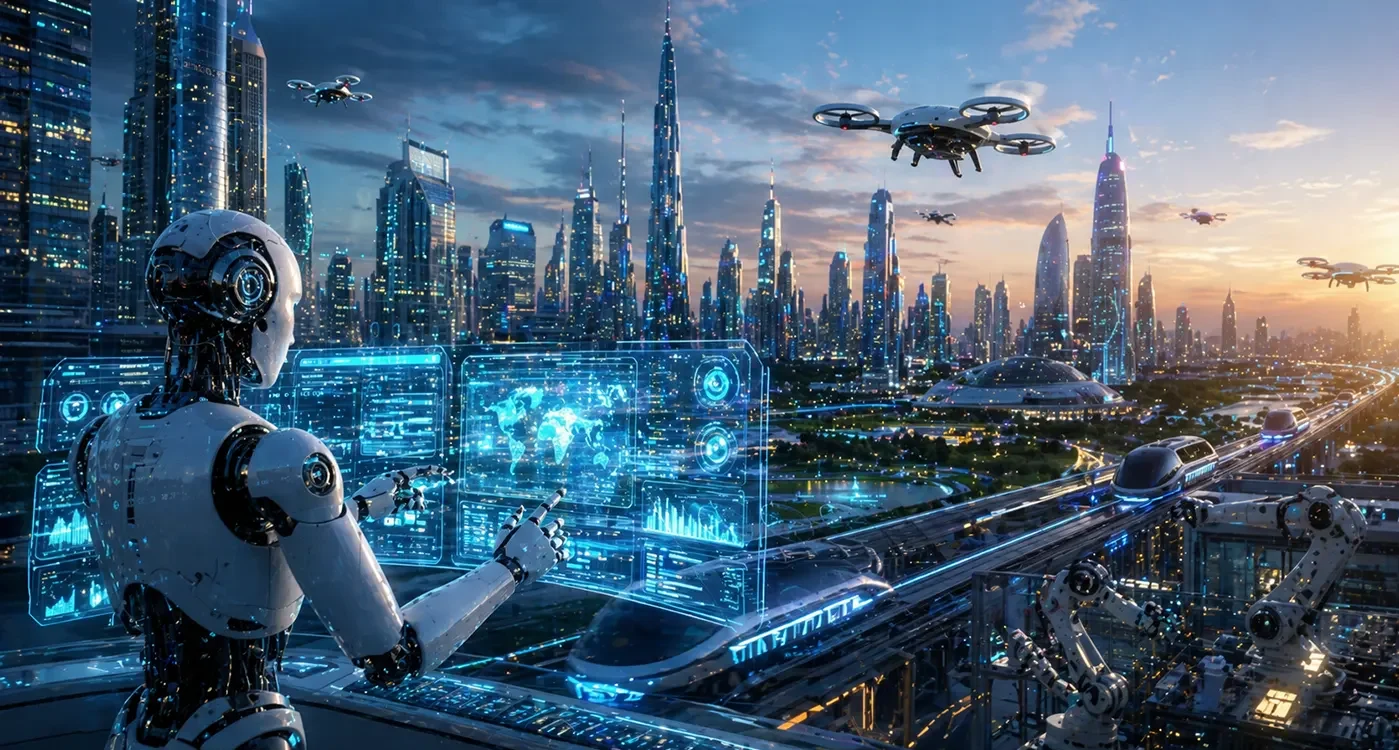
The global economy is currently undergoing a “Twin Transition”—the simultaneous evolution of digital transformation and the shift toward a net-zero, circular economy. By 2026, the demand for green skills has transcended niche environmental sectors, becoming a baseline requirement across finance, engineering, healthcare, and artificial intelligence. However, a significant “green skills gap” persists. To bridge this divide, higher education institutions must move beyond treating sustainability as a peripheral elective and instead embed it into the structural DNA of every degree program.
Integrating sustainability into curricula is no longer a matter of institutional prestige; it is a fundamental requirement for graduate employability and global climate resilience.
1. The “Green Skills” Imperative in the 2026 Labor Market
In the current professional landscape, “green skills” are defined as the knowledge, abilities, values, and attitudes needed to live in, develop, and support a sustainable and resource-efficient society. According to recent LinkedIn and ILO labor market data, job postings requiring at least one green skill have grown by over 30% annually.
For a business graduate, this means understanding Carbon Accounting and ESG (Environmental, Social, and Governance) Reporting. For a software engineer, it involves Green Coding and optimizing algorithms for energy efficiency. The mandate for higher education is clear: every graduate, regardless of their major, must be “green-literate” to navigate a world defined by planetary boundaries.
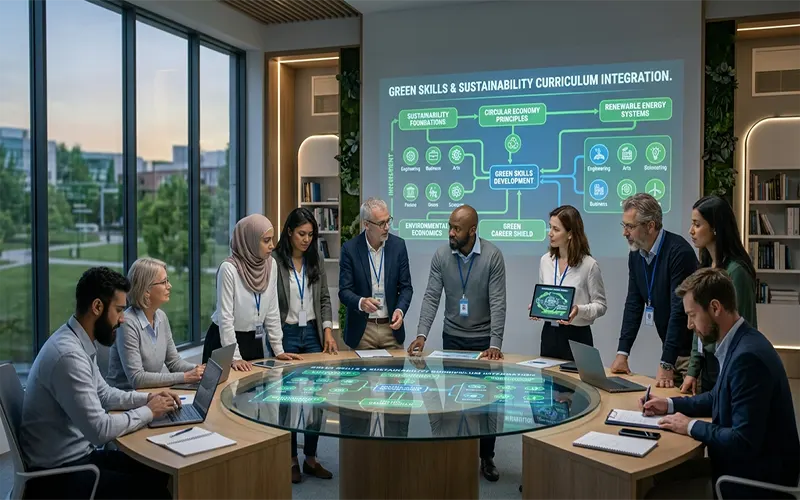
2. A Tri-Level Framework for Curriculum Integration
Drawing on the UNESCO Greening Education Partnership (GEP), leading universities are adopting a three-tiered approach to curricular reform.
I. Vertical Integration: Specialized Green Degrees
This involves the creation of dedicated programs focused on the mechanics of the transition.
- Examples: Masters in Renewable Energy Engineering, BSc in Regenerative Agriculture, or LLM in Global Climate Governance.
- Goal: To produce high-level technical experts who can design the infrastructure of a post-carbon world.
II. Horizontal Integration: The “Green Lens”
This is the most critical shift for mass-market education. It involves embedding sustainability into traditional, “non-environmental” subjects.
- Sustainable Finance: Teaching future bankers how to assess climate risk in investment portfolios.
- Biophilic Design: Integrating ecology into standard Architecture and Urban Planning modules.
- Eco-Ethics: Adding modules on the environmental impact of Large Language Models (LLMs) in Computer Science tracks.
III. Transdisciplinary Competencies (The “Soft” Green Skills)
Beyond technical knowledge, students must develop cognitive frameworks to handle complexity.
- Systems Thinking: The ability to recognize how a decision in one area (e.g., sourcing lithium) impacts another (e.g., local water security).
- Anticipatory Competence: Using climate modeling and trend analysis to plan for multiple future scenarios.
- Normative Competence: The ability to negotiate the ethical trade-offs inherent in sustainability transitions.
3. Pedagogical Innovations: From Theory to Action
By 2026, the “lecture and exam” model is being replaced by immersive, action-oriented learning designed to build agency in students.
The “Living Lab” Model
Universities are increasingly using their own physical infrastructure as a laboratory. Students in engineering might work on optimizing the university’s microgrid, while biology students manage the campus’s carbon sequestration through native reforestation. This provides a safe, controlled environment for students to apply theoretical knowledge to real-world physical systems.
Problem-Based Learning (PBL) and Industry Partnerships
Rather than abstract case studies, curricula are being built around current industry challenges. Students might partner with a local manufacturing firm to perform a Life-Cycle Assessment (LCA) of their packaging, providing the firm with actionable data while earning academic credit.
The Digital-Green Synergy
Modern curricula must address the “Twin Transition.” This involves teaching students how to use AI and Big Data to solve environmental problems. For instance, a data science student might learn to build neural networks that predict solar flare impacts on power grids or use satellite imagery to monitor deforestation in real-time.
4. Institutional Challenges and the Roadmap Forward
Despite the urgency, several bottlenecks slow the “greening” of higher education.
The Faculty Readiness Gap
Surveys show that while over 90% of university faculty believe sustainability is a priority, fewer than 40% feel confident teaching it outside of an environmental science context. Institutional roadmaps must include Professional Development (PD) tracks that help history, art, and math professors find the “green thread” in their respective disciplines.
Accreditation and Quality Standards
The 2026 Green School Quality Standard is beginning to influence university rankings. Institutions are now being evaluated not just on their research output, but on the “Green Literacy” scores of their graduates and the percentage of their curriculum mapped to the UN Sustainable Development Goals (SDGs).
5. Global Policy Catalysts: The UNESCO GEP
The Greening Education Partnership (GEP) has set a global target: by 2030, all learners should be equipped with the knowledge and skills needed to promote sustainable development. In response, 2026 has seen the rise of “Green Skills Awards” and government-funded grants specifically for universities that can demonstrate a successful “whole-institution approach” to sustainability.
Beyond the Diploma
Integrating sustainability into higher education is not simply about adding a new chapter to a textbook; it is about redefining the purpose of the university in the 21st century. A degree in 2026 must be more than a certification of technical skill; it must be a testament to a graduate’s ability to contribute to a Just Transition.
By embedding green skills into the core of the academic experience, higher education institutions ensure that their graduates do not just enter the workforce as passive participants, but as active architects of a resilient, sustainable, and equitable future. The curriculum is the most powerful tool we have to ensure that the leaders of tomorrow are prepared for the world they are actually going to inherit.