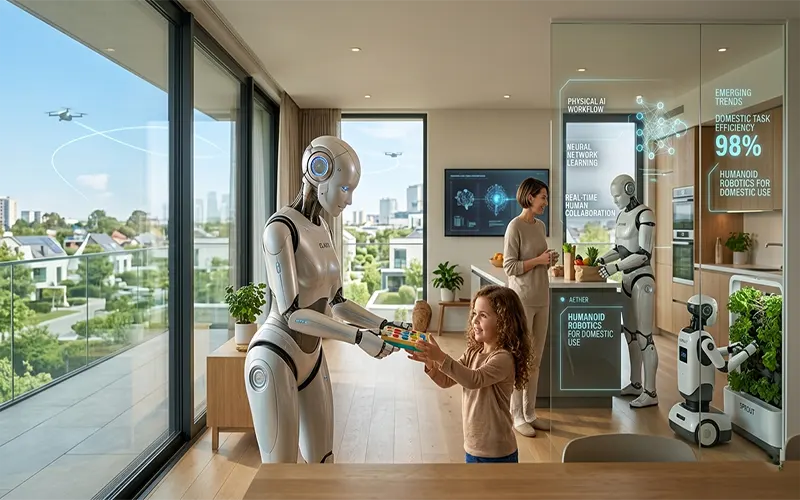
For decades, the “home robot” was a trope of science fiction or a high-end novelty like the vacuum disc. However, as we move through 2026, we are witnessing a fundamental shift from digital AI—trapped behind screens—to Physical AI. This is the era of embodied intelligence, where robots no longer just “think” or “chat” but move, feel, and interact with the chaotic, unstructured environment of the human home.
The convergence of foundation models, advanced actuation, and a graying global population has accelerated the transition of humanoid robots from the factory floor to the foyer.
1. The “Embodied” Revolution: From Code to Contact
The most significant trend in 2026 is the rise of Physical AI. Unlike standard generative AI, which processes text or pixels, Physical AI involves “World Models” that understand the laws of physics. For a robot to be useful at home, it must understand that a glass of water is heavy and fragile, that a rug is a tripping hazard, and that a cat is a sentient being, not an obstacle.
This shift is powered by Vision-Language-Action (VLA) models. These models allow a robot to receive a high-level command like “Clean up the coffee spill” and autonomously decompose it into sub-tasks: locating a cloth, identifying the liquid, applying the correct downward pressure to wipe, and disposing of the soiled rag. We are moving from “programming” robots to “teaching” them through imitation learning and high-fidelity simulations like NVIDIA Isaac Sim.
2. The Rise of General-Purpose Humanoids
In 2026, the debate over “task-specific” versus “general-purpose” robots is leaning heavily toward the latter. The Humanoid form factor has emerged as the winner for domestic use because our homes are built by humans, for humans. Stairs, countertops, and door handles are all designed for a bipedal creature with opposable thumbs.
Key Platforms Leading the Charge:
- 1X NEO: Backed by OpenAI, NEO is the standout for 2026. Weighing only 30 kg (66 lbs) and using “tendon-driven” actuators, it is soft to the touch and moves with a biological fluidity that reduces the “Uncanny Valley” effect.
- Tesla Optimus Gen 2: While initially industrial, the latest consumer-facing iterations focus on “hands” with high degrees of freedom (DOF), capable of handling delicate tasks like threading a needle or folding laundry.
- Unitree G1: At a disruptive price point of approximately $16,000, the G1 is bringing humanoid capabilities to the “prosumer” market, serving as a versatile platform for home research and basic chores.
3. Breakthroughs in 2026: Tactile Sensing and Fine Motor Skills
A robot is only as good as its hands. In 2026, we have moved beyond simple grippers to High-DOF Dexterous Hands equipped with “Electronic Skin.”
- Haptic Feedback: New tactile sensors allow robots to feel the difference between a ripe peach and a tennis ball, adjusting their grip strength in milliseconds.
- Edge Computing (NVIDIA Jetson Thor): The massive computational power required for real-time spatial reasoning is now handled locally on the robot’s “onboard brain,” reducing the latency that previously made autonomous movement jerky or dangerous.
- Few-Shot Learning: Using multimodal LLMs, users can now show a robot a task once—such as how to operate a specific brand of espresso machine—and the robot can generalize that action to perform it autonomously the next time.
4. Primary Use Cases: The “Silver Tsunami” and Domestic Labor
The most urgent driver for domestic humanoids is Elderly Care. With the “Silver Tsunami” leaving a massive gap in the caregiving workforce, robots like the Fourier GR-3 and Hyodol (now integrated with advanced conversational AI) are filling the void.
- Companionship & Monitoring: Beyond physical help, these robots provide emotional support, reminding seniors to take medication and alerting emergency services if they detect a fall or a change in vocal distress.
- The End of Chores: The “Unstructured Labor” of the home—unloading the dishwasher, tidying up toys, or prepping ingredients for dinner—is finally being automated. Unlike a dishwasher, which requires you to load it, a humanoid can walk to the table, pick up the plates, and do the loading for you.
5. The “Uncanny” Hurdles: Privacy and Safety
As these 150-pound metal machines enter our private sanctuaries, two major challenges remain: Privacy and Kinetic Safety.
- The Privacy Paradox: To function, a robot needs constant visual and auditory input. Companies are responding with “Privacy-Preserving Design,” where data is processed locally (on-device) and only “semantic insights” (e.g., “The floor is dirty”) are sent to the cloud, rather than raw video footage.
- Safe-Shutdown Frameworks: New 2026 safety standards (like ISO 25785-1) require robots to have “compliant” joints that yield upon contact with a human and “fail-operational” modes that cause the robot to safely squat or freeze if a system error occurs, preventing it from falling on a resident.
6. Economic Outlook: The $20,000 Price Point
The “Robot-as-a-Service” (RaaS) model is making humanoids accessible. In 2026, a consumer can choose to buy a robot like the 1X NEO for roughly $20,000 (the price of a budget sedan) or lease one for approximately $499/month. This price parity with traditional automobiles suggests that by the end of the decade, a household robot may be as common as a second car.
The transition of AI from the digital world to the physical one represents the next great leap in human evolution. In 2026, domestic humanoids are moving past the “novelty” phase and becoming essential infrastructure for an aging and time-starved population. While technical and ethical hurdles remain, the “Age of Action” has arrived, promising a future where the most tedious aspects of daily life are handled by our silicon-based counterparts, freeing us to focus on the human experiences that matter most.