
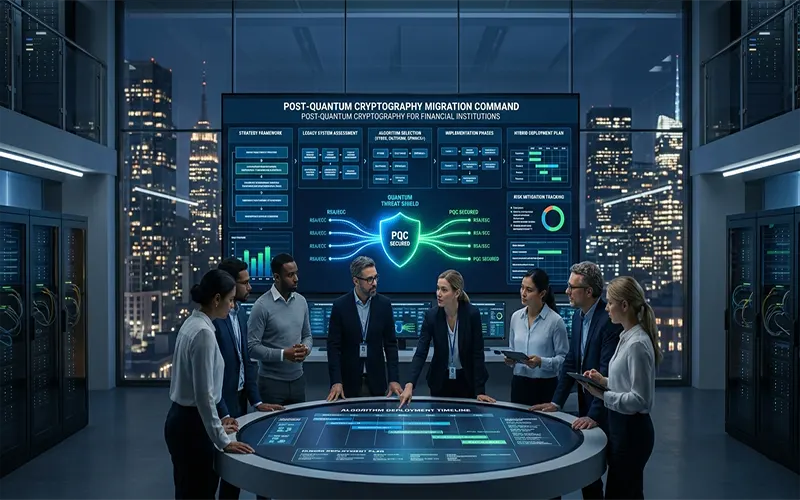
The financial sector operates on a foundation of digital trust. This trust is currently secured by public-key cryptography (RSA, ECC) that relies on the mathematical difficulty of factoring large integers or solving discrete logarithms. However, the horizon of cybersecurity is shifting. With the steady advancement of quantum computing, the algorithms currently shielding trillions of dollars in global assets are facing an existential threat.
For financial institutions, the transition to Post-Quantum Cryptography (PQC) is not a routine patch—it is a mandatory, decade-long modernization of the global financial plumbing.
1. The Dual Threat: “Q-Day” vs. HNDL
The industry often discusses “Q-Day”—the theoretical point at which a Cryptographically Relevant Quantum Computer (CRQC) can execute Shor’s Algorithm to break current encryption. While experts debate whether this is 5, 10, or 15 years away, financial institutions face a more immediate crisis: Harvest Now, Decrypt Later (HNDL).
In an HNDL attack, adversaries intercept and store encrypted sensitive data today, intending to decrypt it once quantum capabilities catch up. For a retail bank, 10-year-old transaction data might be useless, but for an investment firm or a central bank, long-term bond structures, identity records, and sovereign wealth strategies remain sensitive for decades. According to Mosca’s Theorem ($X + Y > Q$), if the time your data must remain secure ($X$) plus the time it takes to migrate your systems ($Y$) exceeds the time to a functional quantum computer ($Q$), you are already in a state of systemic risk.
2. The New Standardized Baseline: NIST FIPS 203, 204, and 205
In late 2024, the National Institute of Standards and Technology (NIST) finalized the primary standards for PQC. Financial architects must now align their roadmaps with these specific algorithms:
| Standard | Original Name | Use Case | Mathematical Basis |
| FIPS 203 | ML-KEM (Kyber) | Key Encapsulation (Secure Key Exchange) | Module Lattice-based |
| FIPS 204 | ML-DSA (Dilithium) | Digital Signatures (General purpose) | Module Lattice-based |
| FIPS 205 | SLH-DSA (SPHINCS+) | Digital Signatures (High security/Back-up) | Stateless Hash-based |
Lattice-based cryptography is the preferred choice for finance due to its balance of security and performance, though it requires significantly larger key sizes and signature lengths than the Elliptic Curve Cryptography (ECC) used today.
3. The Regulatory Imperative
As of 2026, PQC is moving from a “best practice” to a regulatory requirement.
- DORA (Digital Operational Resilience Act): In the EU, financial entities are now required to demonstrate “cryptographic agility” as part of their ICT risk management frameworks.
- CNSA 2.0: The U.S. National Security Agency has set a timeline requiring many government-linked financial systems to move to PQC by 2030, which effectively sets the pace for the global banking inter-network.
- G7 Cyber Expert Group: Recent guidance emphasizes that the interconnectedness of global finance means a “quantum-weak” link in one regional bank can threaten the stability of the entire SWIFT or settlement network.
4. A 5-Step Migration Blueprint for 2026-2030
Migration cannot happen overnight. Financial institutions should adopt a phased approach to manage the complexity of legacy “Mainframe-to-Mobile” environments.
Step 1: Discovery and Cryptographic Inventory
Most banks do not know where their cryptography is. You must identify every instance of RSA and ECC across:
- Core Banking Systems: Often containing hard-coded legacy crypto.
- Hardware Security Modules (HSMs): Determining which can be upgraded via firmware and which require replacement.
- Third-Party APIs: Mapping dependencies on vendors like payment processors or cloud providers.
Step 2: Prioritization by Data Longevity
Not all data is equal. Priority for ML-KEM implementation should be given to:
- Identity and PII: Data that lasts a lifetime.
- Long-term Financial Instruments: 30-year mortgages, life insurance policies, and sovereign debt.
- Root Certificates: The “Trust Anchors” of the bank’s internal PKI.
Step 3: The Hybrid Transition State
To maintain interoperability and mitigate the risk of a “bug” in new PQC algorithms, institutions should use Hybrid Key Exchange. This involves wrapping a traditional key (e.g., ECDH) with a quantum-resistant key (ML-KEM). If the PQC layer is found to have a vulnerability, the classical layer still provides the baseline security we trust today.
Step 4: Achieving Crypto-Agility
The goal is to move away from “hard-wired” cryptography. Banks should transition to a Cryptographic Center of Excellence (CCoE) model where applications call a centralized service for encryption. This allows the security team to swap algorithms (e.g., moving from ML-DSA to a different signature scheme) without rewriting the application code.
Step 5: Supply Chain and Ecosystem Alignment
A bank is only as quantum-secure as its partners.
- SWIFT/ISO 20022: Ensure that messaging standards are updated to handle the larger packet sizes required by PQC signatures.
- Cloud Service Providers: Confirm that your AWS, Azure, or Google Cloud environments have PQC-enabled TLS endpoints available.
5. Technical Challenges: The “Performance Tax”
The move to PQC is not free. Lattice-based algorithms like ML-KEM have much larger public keys and ciphertexts than ECC.
- Latency: For High-Frequency Trading (HFT) environments, the additional milliseconds required for PQC handshakes could impact execution strategies.
- Bandwidth: In mobile banking apps operating in low-bandwidth regions, the increased size of digital signatures could lead to higher failure rates during transaction signing.
- Storage: Signature-heavy audit logs will see a measurable increase in storage requirements, potentially bloating database costs.
6. Modernizing Digital Trust
Post-quantum migration is the most significant cryptographic transition in the history of modern finance. While the technical hurdles are steep, the process offers a unique opportunity to clear out “cryptographic debt”—the decades of legacy, undocumented security protocols that have accumulated in banking cores.
By 2026, the question is no longer whether a quantum computer will arrive, but whether your institution has built the cryptographic agility to survive its arrival. Those who begin the migration now—prioritizing long-term data and building hybrid defenses—will define the standard of trust for the next fifty years of global finance.