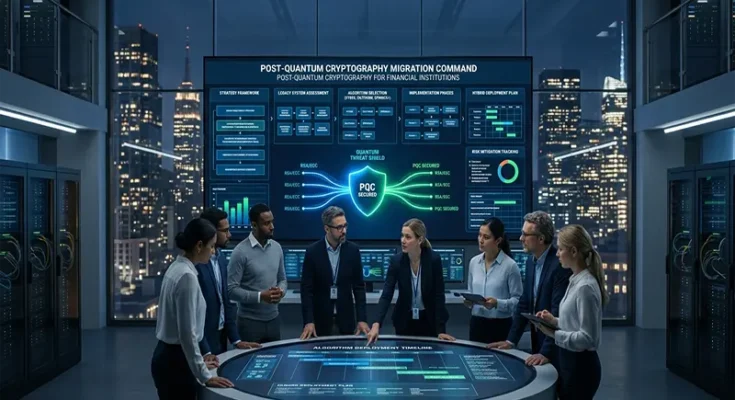
Post-Quantum Cryptography Migration Strategies for Financial Institutions

Post-Quantum Cryptography Migration Strategies for Financial Institutions

The financial sector operates on a foundation of digital trust. This trust is currently secured by public-key cryptography (RSA, ECC) that relies on the mathematical difficulty of factoring large integers or solving discrete logarithms. However, the horizon of cybersecurity is shifting. With the steady advancement of quantum computing, the algorithms currently shielding trillions of dollars in global assets are facing an existential threat.

For financial institutions, the transition to Post-Quantum Cryptography (PQC) is not a routine patch—it is a mandatory, decade-long modernization of the global financial plumbing.

1. The Dual Threat: “Q-Day” vs. HNDL

The industry often discusses “Q-Day”—the theoretical point at which a Cryptographically Relevant Quantum Computer (CRQC) can execute Shor’s Algorithm to break current encryption. While experts debate whether this is 5, 10, or 15 years away, financial institutions face a more immediate crisis: Harvest Now, Decrypt Later (HNDL).

In an HNDL attack, adversaries intercept and …

Post-Quantum Cryptography Migration Strategies for Financial Institutions Read More
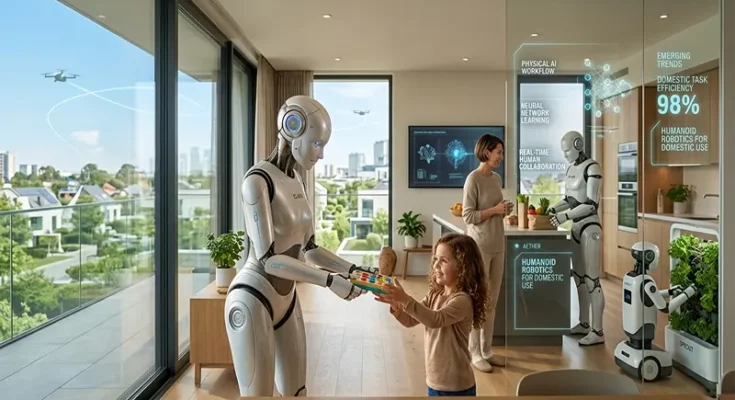
Emerging Trends in Physical AI and Humanoid Robotics for Domestic Use

Emerging Trends in Physical AI and Humanoid Robotics for Domestic Use

For decades, the “home robot” was a trope of science fiction or a high-end novelty like the vacuum disc. However, as we move through 2026, we are witnessing a fundamental shift from digital AI—trapped behind screens—to Physical AI. This is the era of embodied intelligence, where robots no longer just “think” or “chat” but move, feel, and interact with the chaotic, unstructured environment of the human home.

The convergence of foundation models, advanced actuation, and a graying global population has accelerated the transition of humanoid robots from the factory floor to the foyer.

1. The “Embodied” Revolution: From Code to Contact

The most significant trend in 2026 is the rise of Physical AI. Unlike standard generative AI, which processes text or pixels, Physical AI involves “World Models” that understand the laws of physics. For a robot to be useful at home, it must understand that a glass of …

Emerging Trends in Physical AI and Humanoid Robotics for Domestic Use Read More
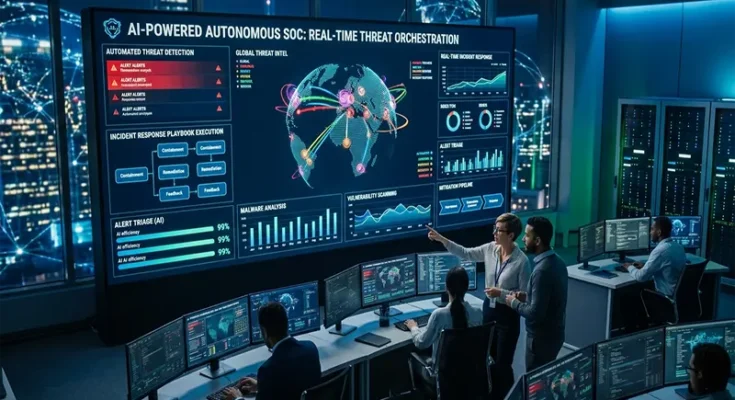
AI-Powered Autonomous SOC for Real-Time Threat Orchestration

AI-Powered Autonomous SOC for Real-Time Threat Orchestration

The traditional Security Operations Center (SOC) is under siege. As cyber adversaries weaponize generative AI to automate phishing, polymorphic malware, and credential stuffing, the gap between “Time to Compromise” and “Time to Detect” is widening. Human-centric SOCs are currently drowning in a sea of telemetry: a typical enterprise receives over 10,000 alerts per day, of which nearly 50% are false positives or duplicates.

The result is alert fatigue, a condition where critical indicators of compromise (IoCs) are buried under noise, and the Mean Time to Remediate (MTTR) is measured in days, not minutes. To survive the next generation of cyber warfare, organizations must pivot from reactive monitoring to an AI-Powered Autonomous SOC—a system capable of real-time threat orchestration without waiting for a human to click “approve.”

1. The Crisis of the Modern SOC: The Human Bottleneck

The fundamental flaw in modern cybersecurity is the mismatch in speed. Ransomware …

AI-Powered Autonomous SOC for Real-Time Threat Orchestration Read More
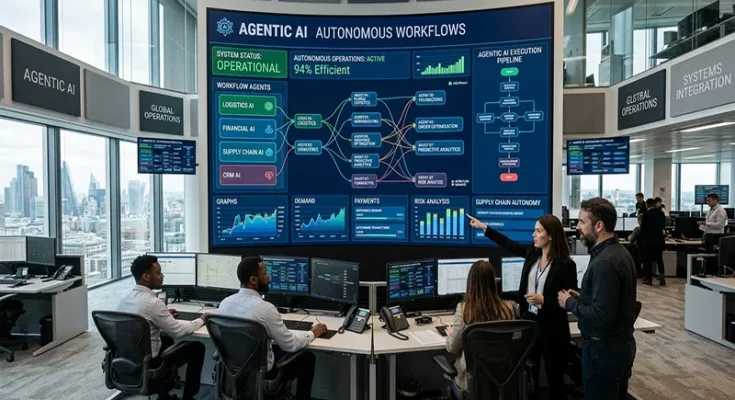
Implementation of Agentic AI Workflows for Autonomous Business Operations

Implementation of Agentic AI Workflows for Autonomous Business Operations

The evolution of enterprise automation has reached a critical inflection point. For the past decade, Robotic Process Automation (RPA) provided a rigid, rule-based framework for handling repetitive tasks. However, RPA fails when faced with ambiguity, shifting variables, or unstructured data. Enter Agentic AI: a paradigm shift from linear scripts to autonomous reasoning engines.

By implementing agentic workflows, businesses are transitioning from “AI as a tool” to “AI as a teammate,” capable of orchestrating complex sequences of actions to achieve high-level business objectives without constant human intervention.

1. The Shift: From Linear Automation to Agentic Reasoning

Traditional automation is deterministic; if $X$ happens, do $Y$. While efficient, this model is fragile. Agentic AI, powered by Large Language Models (LLMs) and specialized reasoning frameworks, operates on probabilistic logic.

The core differentiator is the Reasoning Loop. Unlike a standard chatbot that simply predicts the next token in a sentence, an …

Implementation of Agentic AI Workflows for Autonomous Business Operations Read More