
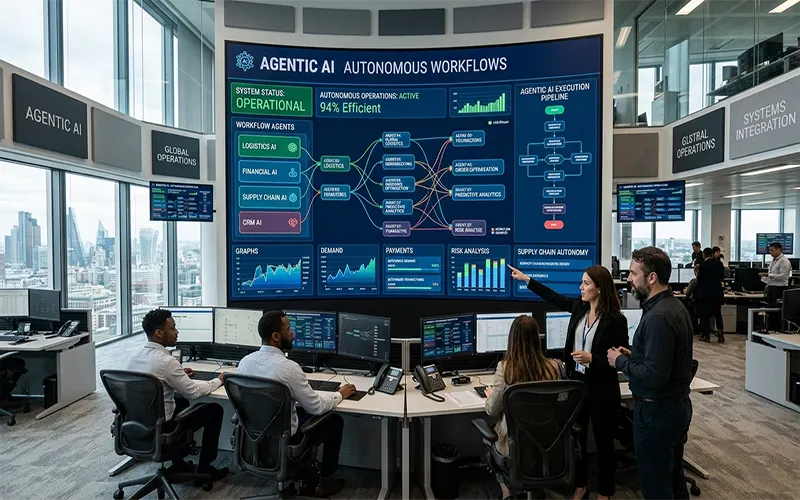
The evolution of enterprise automation has reached a critical inflection point. For the past decade, Robotic Process Automation (RPA) provided a rigid, rule-based framework for handling repetitive tasks. However, RPA fails when faced with ambiguity, shifting variables, or unstructured data. Enter Agentic AI: a paradigm shift from linear scripts to autonomous reasoning engines.
By implementing agentic workflows, businesses are transitioning from “AI as a tool” to “AI as a teammate,” capable of orchestrating complex sequences of actions to achieve high-level business objectives without constant human intervention.
1. The Shift: From Linear Automation to Agentic Reasoning
Traditional automation is deterministic; if $X$ happens, do $Y$. While efficient, this model is fragile. Agentic AI, powered by Large Language Models (LLMs) and specialized reasoning frameworks, operates on probabilistic logic.
The core differentiator is the Reasoning Loop. Unlike a standard chatbot that simply predicts the next token in a sentence, an AI Agent uses a “Chain of Thought” process to decompose a complex goal (e.g., “Optimize our Q3 supply chain for a 15% increase in fuel costs”) into a series of actionable sub-tasks. This ability to self-correct, iterate, and navigate uncertainty is what enables truly autonomous business operations.
2. The Four Pillars of Agentic Architecture
To implement a robust agentic workflow, an organization must build upon four foundational architectural pillars:
I. Planning and Task Decomposition
Autonomous agents do not tackle a project as a single prompt. They use techniques like ReAct (Reasoning and Acting) to break down a mandate.
- Step-by-step Planning: The agent identifies which sub-tasks are sequential and which can be parallelized.
- Self-Reflection: Advanced agents “critique” their own plans before execution, identifying potential bottlenecks or logic gaps.
II. Memory Systems: Short-term vs. Long-term
An agent without memory is a worker with amnesia.
- Short-term Memory: Utilizes the model’s context window to maintain the state of the current task.
- Long-term Memory: Employs Vector Databases and Retrieval-Augmented Generation (RAG). This allows the agent to pull historical data, corporate policies, or past project results to inform current decision-making.
III. Tool Use (The “Hands” of the Agent)
Reasoning is useless if the agent cannot act. Through Function Calling, agents are granted access to an organization’s software stack:
- APIs: To pull real-time market data or weather reports.
- ERPs and CRMs: To update inventory levels or modify customer records in Salesforce.
- Code Interpreters: To run Python scripts for real-time data visualization and analysis.
IV. Multi-Agent Orchestration
The most sophisticated implementations involve a Multi-Agent System (MAS). Rather than one “God-Agent,” businesses deploy specialized agents—a “Financial Analyst Agent,” a “Logistics Coordinator Agent,” and a “Compliance Overseer.” These agents communicate via an orchestration layer, peer-reviewing each other’s work and escalating conflicts to human supervisors when necessary.
3. A Roadmap for Implementation
Moving from a pilot program to full-scale autonomous operations requires a disciplined, four-stage roadmap.
Stage 1: Identifying High-ROI “Agentic” Use Cases
Not every process needs an agent. The best candidates are high-complexity, high-variability tasks.
- Example: Dynamic Procurement. An agent monitors global news for political instability, cross-references it with current supplier locations, and autonomously drafts alternative sourcing contracts for review.
Stage 2: Building the “Human-in-the-Loop” (HITL) Framework
Autonomy does not mean an absence of oversight. Implementation must include governance checkpoints.
- Gatekeeping: For high-stakes actions (e.g., executing a $50,000 wire transfer), the agent prepares the action but requires a digital signature from a human manager.
- Feedback Loops: When a human corrects an agent’s output, that correction is fed back into the agent’s long-term memory to refine future performance.
Stage 3: Technical Integration and Orchestration
This involves selecting the right orchestration framework (e.g., LangGraph, AutoGen, or CrewAI). The technical team must map the Agent-Tool topology, ensuring the agent has the necessary permissions to read/write to the required databases without compromising security.
Stage 4: Evaluation and “AgentOps”
Unlike traditional software, AI agents are non-deterministic. Businesses must implement AgentOps—a continuous monitoring system that tracks:
- Success Rate: Did the agent achieve the goal?
- Cost-per-Task: Is the LLM token spend providing a positive ROI?
- Latency: Is the reasoning loop fast enough for real-time operations?
4. Challenges: Governance, Ethics, and Hallucinations
The implementation of agentic AI is not without significant hurdles.
- The Hallucination Risk: In an autonomous loop, a single “hallucinated” fact can cascade into a series of incorrect actions. Mitigation requires Multi-Agent Cross-Checking, where a secondary “Verifier Agent” audits the output of the “Worker Agent.”
- Data Privacy: Agents often require access to sensitive proprietary data. Organizations must ensure that LLMs are hosted in secure, private VPC environments and that data used for RAG is properly scrubbed of PII (Personally Identifiable Information).
- Displacement and Culture: The shift to autonomous operations can create anxiety within the workforce. Successful implementation requires a cultural shift where employees are upskilled from “doers” to “agent managers” or “orchestrators.”
5. The Future: The “Self-Driving” Enterprise
By 2030, the competitive landscape will be divided between companies that use AI as a search engine and those that use AI as an operational engine.
The implementation of agentic AI workflows allows for a “Self-Driving” Enterprise. In this model, the executive leadership sets the high-level strategy and guardrails, while a hierarchy of AI agents manages the day-to-day tactical execution—from inventory management and lead generation to financial reporting and IT support.
This level of autonomy offers unprecedented scalability. Unlike a human workforce, an agentic workforce can be scaled up or down instantly in response to market demand, with marginal costs approaching zero.
Implementation of agentic AI is no longer a futuristic luxury; it is a strategic imperative. By building systems capable of planning, remembering, and acting, businesses can transcend the limitations of traditional automation. The journey toward autonomous operations is complex, requiring a blend of technical prowess and rigorous governance, but the reward is a business that is faster, smarter, and infinitely more adaptable to the complexities of the modern global economy.