
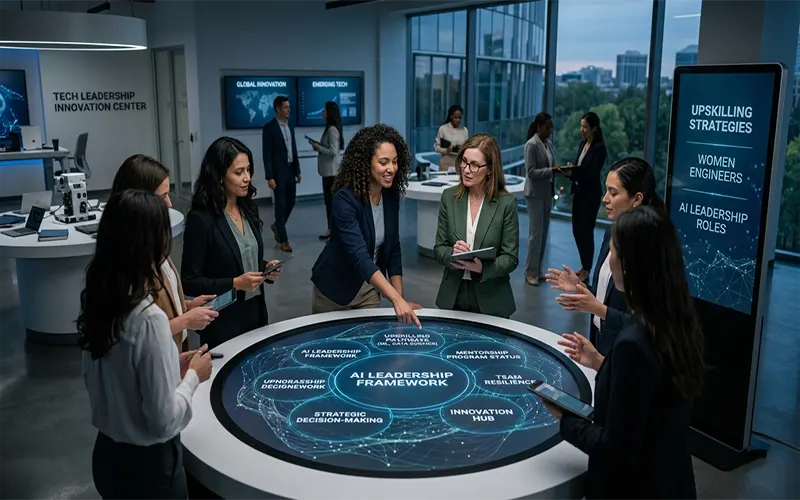
The year 2026 marks a pivotal era in the technological landscape. While the initial “AI gold rush” was defined by rapid experimentation and raw coding, the current phase is defined by Autonomous Orchestration, Ethical Governance, and Strategic Integration. For women engineers, who currently make up a significant portion of the technical workforce but remain underrepresented in the C-suite, this shift represents a massive opportunity.
Transitioning from a “Builder” (Software or Data Engineer) to an “Architect of Strategy” (Director of AI or CAIO) requires a deliberate pivot. It is no longer enough to be the person who writes the most efficient code; you must be the leader who understands the unit economics, ethical guardrails, and long-term organizational impact of agentic systems.
1. The 2026 AI Leadership Gap
Despite the maturation of the industry, a “leadership gap” persists. Women engineers often find themselves trapped in “high-intensity execution” roles—debugging complex RAG (Retrieval-Augmented Generation) pipelines or cleaning massive datasets—while strategic decisions are made elsewhere.
To bridge this gap, the transition must be viewed through the lens of Technical Authority combined with Strategic Vision. Leadership in 2026 isn’t about moving away from technology; it’s about elevating your technical expertise to influence the boardroom.
2. The “Technical Plus” Upskilling Core
Leadership roles in AI today demand a specific set of advanced technical competencies that go beyond standard model training. To lead a department, you must master the following:
I. Agentic Workflow Design and Orchestration
The focus has shifted from single-model chat interfaces to Multi-Agent Systems (MAS). As a leader, you must understand how to architect workflows where different AI agents (e.g., a “Researcher Agent,” a “Coder Agent,” and a “Compliance Agent”) interact autonomously.
II. AI Infrastructure and Cost Modeling
One of the most critical “leadership” skills in 2026 is Inference Economics. You must be able to calculate the ROI of a project by understanding:
- GPU Cluster Utilization: The cost trade-offs between on-premise H100/B200 clusters vs. serverless cloud inference.
- Latency vs. Accuracy: Making the strategic call on when to use a “small” specialized model vs. a massive frontier model.
III. Quantum-Safe AI and Security
With the rise of Post-Quantum Cryptography (PQC), leaders must ensure that their AI models—which often handle sensitive proprietary data—are “Quantum-Safe.” Understanding the intersection of AI security and data privacy is now a non-negotiable leadership trait.
3. The Strategic Leadership Toolkit
Beyond the code, the transition to leadership is defined by your ability to manage risk, people, and policy.
| Skill Area | Builder Focus (Individual Contributor) | Leader Focus (Director/VP/CAIO) |
| Governance | Following security protocols. | Interpreting the EU AI Act (2026) & setting internal policy. |
| Communication | Explaining a pull request. | Evangelizing AI ROI to a non-technical Board. |
| Management | Completing a sprint. | Leading a team through “Automation Anxiety.” |
| Economics | Optimizing token usage. | Managing a multi-million dollar AI infrastructure budget. |
AI Governance and Ethical Policy
Mastery of the EU AI Act and its global equivalents is now mandatory. A woman leader in AI must be the “voice of reason” in the room, ensuring that “Move Fast and Break Things” doesn’t lead to “Move Fast and Get Fined.” This includes setting standards for Algorithmic Bias Audits and Explainability (XAI).
4. Overcoming the “Broken Rung”
The “Broken Rung” refers to the first step up into management where women are often overlooked. In the AI sector, this is frequently due to Strategic Visibility.
- From Invisible to Visible Labor: Many women engineers excel at the “invisible” work that makes AI function (data cleaning, documentation, safety testing). To transition to leadership, you must pivot toward high-visibility projects: product vision, IP strategy, and revenue-generating AI features.
- Sponsorship > Mentorship: A mentor will give you advice; a Sponsor will mention your name in a room full of executives. Seeking out C-suite sponsors who can advocate for your technical vision is the fastest way to break the glass ceiling in 2026.
5. A 12-Month Transition Roadmap
If you are currently a Senior or Staff Engineer, use this roadmap to pivot toward a leadership role within the next year.
Months 1–4: Foundations of AI Management
- Certification: Obtain an AI Ethics and Governance Certification (e.g., IAPP CIPP/AI).
- Technical Pivot: Move from “training models” to mastering LLMOps (Large Language Model Operations)—the lifecycle management of AI in production.
Months 5–8: The Cross-Functional Pilot
- Lead a Project: Volunteer to lead a cross-functional AI pilot that involves at least three departments (e.g., Engineering, Legal, and Marketing). This proves you can speak multiple “corporate languages.”
- Cost Analysis: Create a “Unit Economics” report for your current project. Present it to your manager, showing how you saved the company money through model optimization.
Months 9–12: Executive Presence and Influence
- The “Boardroom AI” Simulation: Practice presenting your AI strategy to non-technical audiences. Can you explain “Vector Databases” in two sentences without using jargon?
- Build Your Network: Attend executive-level summits (like the Women in AI Ethics or Global AI Summit) specifically for networking with CAIOs and VPs.
6. The Power of Human-Centric AI Leadership
The future of AI is not just about raw power; it is about Integration and Empathy. As we move toward a world of autonomous operations, the most successful leaders will be those who can balance technical rigor with a deep understanding of human impact.
Women engineers are uniquely positioned to lead this “Human-Centric” AI future. By upskilling in Agentic Architecture, AI Economics, and Ethical Governance, you move from being the person who implements the future to the person who designs it. The transition to AI leadership is less about leaving your engineering roots behind and more about using those roots to grow a strategy that can sustain an entire organization.