
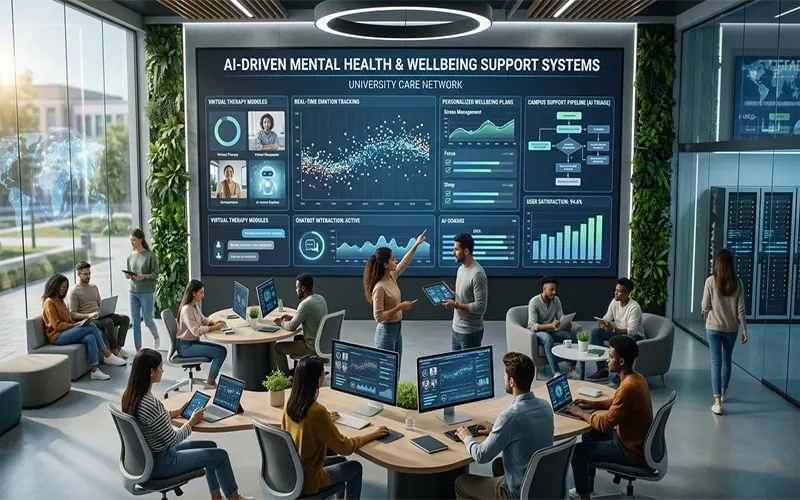
The modern university campus is facing a silent crisis. In 2026, despite increased awareness, student mental health remains at a breaking point. Loneliness, “digital burnout,” and the relentless pressure of the global labor market have created a demand for support that far outpaces the capacity of traditional campus counseling centers. With waiting lists often stretching into months, universities are turning to AI-Driven Wellbeing Support Systems—not as a replacement for human therapists, but as a sophisticated, 24/7 triage and early-intervention layer that ensures no student falls through the cracks.
By integrating “Empathic AI” with clinical frameworks, institutions are moving toward a proactive model of care that identifies distress before it reaches a state of crisis.
1. The Stepped Care 4.0 Framework
The most effective university implementations in 2026 follow the Stepped Care 4.0 model. This framework uses AI to match the intensity of the intervention to the specific needs of the student, optimizing limited human resources for the most complex clinical cases.
Tier 1: Proactive Wellness and “Digital Phenotyping”
At the foundational level, AI monitors a student’s “wellness baseline.” Through Digital Phenotyping, with explicit student consent, AI can analyze subtle changes in behavior—such as disrupted sleep patterns detected by wearables, reduced physical mobility, or a sudden drop in LMS (Learning Management System) engagement.
- Action: The system sends a “nudge,” such as a suggestion for a guided meditation or a reminder to maintain a consistent sleep schedule, preventing a minor dip from becoming a major episode.
Tier 2: Low-Intensity Support (The Conversational Tier)
For students experiencing manageable levels of anxiety, loneliness, or academic stress, Generative AI Agents provide immediate, evidence-based support. Unlike the rigid chatbots of the past, these agents utilize Cognitive Behavioral Therapy (CBT) and Dialectical Behavior Therapy (DBT) modules to help students reframe negative thought patterns in real-time.
Tier 3: Crisis Detection and Triage
This is the “safety net that never sleeps.” Using advanced Natural Language Processing (NLP), the AI scans student interactions for high-risk markers, such as mentions of self-harm, hopelessness, or substance abuse.
- Action: The AI immediately escalates the case to a human crisis team, providing them with a summarized context of the student’s recent interactions to speed up the intervention process.
2. Comparing Support Models
| Feature | Traditional Campus Counseling | AI-Enhanced Support System |
| Availability | 9 AM – 5 PM (Business Days) | 24/7/365 |
| Wait Time | 2–6 Weeks (Average) | Instantaneous |
| Approach | Reactive (Student must seek help) | Proactive (System detects shifts) |
| Stigma | High (Requires physical visit) | Low (Private, digital interaction) |
| Complexity | Best for high-risk/clinical cases | Best for triage and sub-clinical care |
3. The Rise of “Empathic” and Agentic AI
The breakthrough of 2026 is the shift from “Instructional AI” to “Empathic Agentic AI.” These systems are no longer just responding to prompts; they maintain long-term context.
- Long-term Context: If a student mentions an upcoming difficult exam on Monday, the AI might check in on Tuesday morning to ask how they are feeling, mimicking the supportive follow-up of a human mentor.
- Multimodal Sentiment Analysis: By analyzing the tone of a student’s voice during a “voice-journaling” session or the speed and sentiment of their typing, the AI can detect a “flat” or “depressed” affect even if the words themselves are neutral.
4. Ethical Safeguards and “Safety-by-Design”
Implementing AI in a mental health context requires the highest level of ethical rigor. Universities must address three primary pillars:
I. The Bias Trap and Cultural Responsiveness
AI models must be trained on diverse datasets to ensure they do not offer “one-size-fits-all” Western-centric advice. For international students, the AI must be Culturally Responsive, recognizing that stigma and the language used to describe “sadness” or “pressure” vary significantly across different cultures and languages.
II. Safety and “Hallucination” Management
In a mental health context, an AI giving incorrect or “hallucinated” advice can be life-threatening. Universities utilize RAG (Retrieval-Augmented Generation) to ensure the AI’s advice is strictly anchored in peer-reviewed clinical manuals and university-approved protocols.
III. Data Sovereignty (GDPR 2.0 and HIPAA-AI)
Student mental health data is hyper-sensitive. The 2026 standard is On-Device or Private-Cloud Processing, ensuring that a student’s journaling or mood data is never used to train global models. Data must be siloed, encrypted, and accessible only to the student and, in high-risk cases, their authorized clinical team.
5. Implementation Strategy: The “Academic Burnout” Radar
To operationalize these systems, universities are integrating AI support directly into the Learning Management System (LMS).
- Early Warning Systems: If an AI identifies that a student’s grades are slipping in tandem with a decrease in extracurricular participation and an increase in “late-night” digital activity, it can flag the student for a “wellness check-in.”
- Peer-AI Collaboration: Universities are training “Student Wellness Ambassadors” to act as the human bridge. These peers can help students navigate the AI tools, providing a human face to the digital system and further reducing the stigma associated with seeking help.
6. The Future of the “Thriving Campus”
The goal of AI-driven mental health support is not to automate the soul of the university, but to restore it. By handling the high-volume, low-intensity needs of the student population, AI allows human counselors to do what they do best: provide deep, empathetic, and complex clinical care to those who need it most.
In 2026, the “Thriving Campus” is defined by a hybrid model of care. It is a place where technology acts as a vigilant, invisible guardian, ensuring that in the high-pressure environment of higher education, every student has a safe, immediate, and non-judgmental space to turn to at 3:00 AM. When we leverage AI to build a “safety net that never sleeps,” we ensure that academic success never comes at the cost of human wellbeing.