
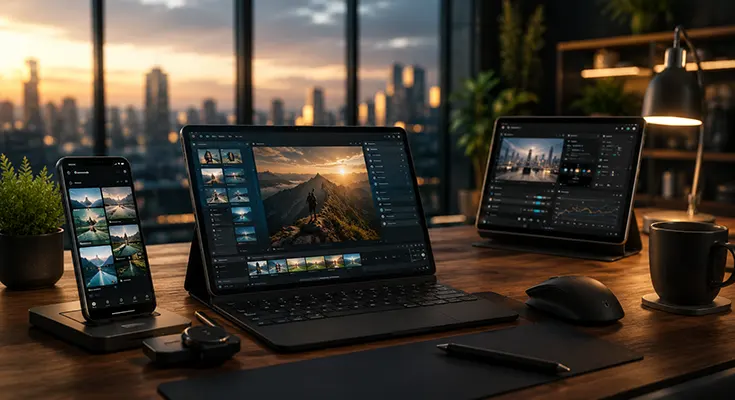
The contemporary definition of professional productivity has outgrown the physical limits of a traditional office desk. Today’s corporate landscape demands high-speed decision-making, continuous creative workflows, and immediate data access while moving seamlessly between transit, remote meeting spaces, and varying work locations. To meet these intensive demands without returning to heavy laptops, a major trend has emerged: constructing a decentralized, high-performance mobile workstation by combining an ultra-premium flagship smartphone with a large-format companion device.
When these devices operate in isolation, they are highly capable tools. However, when linked through a unified, low-latency ecosystem layer, they transform into a synergistic workspace where hardware capabilities are shared seamlessly. Pairing an ultra-premium phone with an expansive samsung tablet creates a production pipeline that balances pocketable power with deep analytical visual canvas spaces.
Understanding how this connected environment operates—especially when the initial financial barrier is softened by regional trade structures, such as the highly competitive s25 ultra price in uae—shows why modern mobile ecosystems have become the definitive configuration for modern professionals.
The Technology of Inter-Device Continuity
At the core of a high-performance multi-device workstation is the data transport layer that connects the two devices. Rather than relying on clunky manual cloud transfers or slow legacy wireless pairings, modern ecosystem hardware establishes an invisible, high-bandwidth local wireless fabric.
By combining Wi-Fi 7 dual-band channels with Bluetooth Low Energy (LE) and Ultra-Wideband (UWB) proximity tracking, a flagship phone and a premium samsung tablet maintain constant awareness of their spatial positions relative to one another. This constant communication drives several key productivity workflows:
- Cross-Device Multi Control: This feature enables a user to use a single physical keyboard cover and mouse trackpad attached to their tablet to navigate across both screens smoothly. Move the cursor past the boundary of the tablet glass, and it enters the smartphone screen, allowing direct control, text input, and command execution without changing input devices.
- Universal Clipboard Integration: Text blocks copied from a mobile communication channel or web browser on the phone are instantly stored in a shared RAM cache. The user can immediately long-press on a presentation deck open on the tablet and paste the asset, completely bypassing external file routing apps.
- Dynamic Smart Switching: Audio layers adjust instantly. If a user is reviewing multimedia assets via wireless earbuds connected to the large tablet screen and a voice call hits the primary phone line, the hardware senses the priority shift. It reroutes the acoustic channel to the phone smoothly, then snaps back to the media layout the moment the call concludes.
Architectural Screen Extensions: Transforming Tablets into Second Screens
One of the largest bottlenecks when working exclusively on a mobile device is the lack of visual workspace. Split-screen multi-tasking on a 6.9-inch screen is excellent for quick cross-references, but handling complex layout design or data tracking requires significantly larger screen space.
Second Screen Projection
Through optimized local streaming protocols, a premium samsung tablet can serve as an absolute zero-latency secondary screen for Windows-based or local ecosystem operating frameworks. This screen extension runs at native refresh rates up to 120Hz, ensuring that fine vector illustrations, data graphs, or scrolling lines remain perfectly sharp.
The Fluid Drag-and-Drop Pipeline
Consider a content creation or editing workflow. High-resolution 200MP raw photographs or multi-stream 4K videography footage can be captured directly using the high-end camera sensor array on the smartphone.
Instead of waiting for heavy cloud syncing over mobile data, the local multi-device network allows the user to open the gallery icon on the tablet interface, locate the phone’s storage partition directly via an integrated file manager, and drag the heavy file across the screen boundaries. The file transfers via a direct peer-to-peer Wi-Fi connection, placing the asset right onto the tablet’s expansive 14.6-inch canvas for fine-grain editing with the active stylus pen.
Regional Procurement Advantages: The GCC Electronics Market
Building an elite mobile workstation requires significant investment, as purchasing both a top-tier flagship phone and a large-format tablet sits at the top of hardware pricing tiers. However, the economic structure of regional markets can drastically impact the total cost of ownership.
For global business travelers and local professionals tracking tech investments, the s25 ultra price in uae market represents a highly optimized financial entry point. The region benefits from a transparent 5% flat Value Added Tax framework, completely free of the steep compounding luxury electronics tariffs or import surcharges that drive device costs up in other global territories.
Because local distribution networks pass these logistics and structural tax advantages directly down to the consumer level, the outright cost for a 12GB RAM and 256GB baseline configuration sits at a highly competitive baseline right at launch. This clean pricing structure frees up capital within a tech budget, making it much easier to add an enterprise-grade samsung tablet into the deployment to complete a dual-device mobile workstation.
Active Stylus Integration and Creative Flexibility
A primary engineering feature that unifies these two form factors is the use of matching Electromagnetic Resonance (EMR) digitizer layers behind the display panels. This technology allows a single, passive input tool to deliver high-precision performance across both devices without requiring internal batteries or constant Bluetooth re-pairing.
Low-Latency Digitizers
On a massive flagship tablet panel, the passive stylus operates with a near-zero latency down to 2.8 milliseconds. The digitizing matrix tracks up to 4,096 distinct levels of pressure sensitivity, alongside angle inclination sensing. This turns the tablet into a high-end drawing and design surface, ideal for architectural sketching, corporate wireframing, or detailed document annotation.
The Portability Companion
When the user steps away from the main workstation and shifts to a mobile environment, the same input habits follow them. The smartphone variant features its own built-in active pen compartment, ensuring that quick thoughts, signatures, and document markups can occur on the move. The shared software foundation ensures that handwritten notes taken on either device sync instantaneously to a single secure notebook profile, available across the entire hardware network.
Silicon Uniformity and Sustained Workflows
The operational continuity of a dual-device workstation is further enhanced by matching performance architectures. When both the smartphone and the companion tablet leverage matching high-tier mobile processing frameworks—such as custom-tuned Snapdragon 8 Elite systems built on high-efficiency 3nm nodes—the user experiences absolute uniformity in application response times.
Heavy enterprise software packages, including mobile CAD suites, advanced video editing software, and complex localized artificial intelligence modules, run with identical speed and behavior regardless of which screen is currently active. Furthermore, because both devices utilize advanced thermal architectures with extended internal vapor cooling chambers, they can handle sustained peak processing loads without thermal throttling, keeping professional workflows smooth and predictable all day long.
The Modern Work Paradigm Unlocked
Constructing a high-performance workstation around a connected flagship phone and a large samsung tablet represents the peak of modern mobile productivity design. By breaking free from the limits of a single screen and utilizing high-speed local wireless communication networks, this dual-device approach successfully delivers desktop-class performance in a highly flexible, portable package.
When this hardware integration is backed by open-border commercial hubs—where competitive local conditions optimize benchmarks like the s25 ultra price in uae—investing in a comprehensive, connected multi-device ecosystem transitions from an expensive luxury into a highly practical, forward-looking strategic move for the modern professional.